RNG Explained — Australia
How a random number generator turns a seed into a reel stop, how GLI tests it and why no pokie is ever due. Run the simulator and watch real streaks form.

Independent information site. We may earn a commission from the links on this page.
On this page
How an RNG works, with real numbers
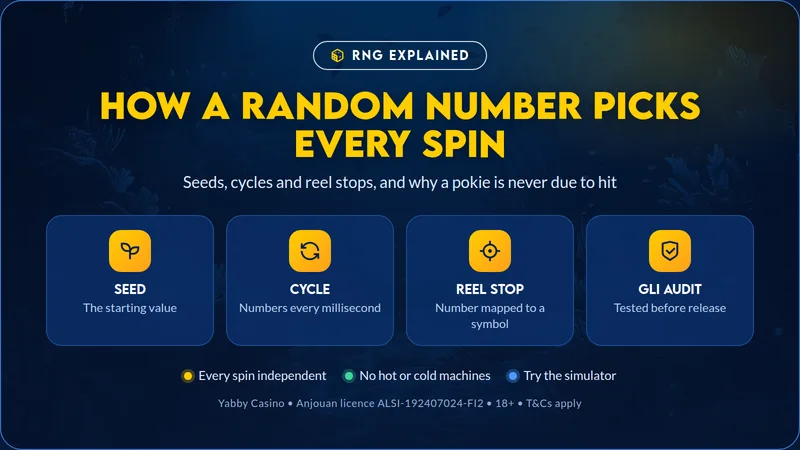
A pokie does not “spin” in any mechanical sense. Software draws a number, the number picks a position on each reel strip, and the animation you watch is just the result being shown. Here is one spin from start to finish, using the same small generator (mulberry32) that powers the simulator below.
- The seed sets the starting point
Every generator starts from an internal state called the seed. For this example I used 20260924. A casino-grade RNG is never seeded from the clock alone and keeps mixing in fresh entropy, so nobody outside can work out where it is.
- Each draw produces a 32-bit number
From that seed the first three draws are 2,310,916,596, then 2,889,406,783, then 3,520,029,838. Each is a whole number between 0 and 4,294,967,295 (232 − 1).
- Scaling maps it onto a reel strip
Say each reel has 64 virtual stops. Divide the draw by 4,294,967,296 and multiply by 64: 0.5381 × 64 lands on stop 34 for reel one, 0.6727 × 64 on stop 43 for reel two and 0.8196 × 64 on stop 52 for reel three.
- The paytable reads the stops
The game looks up which symbols sit at stops 34, 43 and 52 and pays whatever line they form. If four of the 64 stops on each reel carry the top symbol, three in a row comes up (4/64)3 = 1 time in 4,096 spins on average.
- The reels animate the answer
Only now do the reels move. The outcome was settled when you pressed spin, so stopping early changes nothing.
Streak simulator
Press Run. Streaks are normal: a fair generator produces long dry runs as a matter of course, and the same seed always replays the same sequence.
How testing labs certify an RNG
A random number generator is only as trustworthy as the people who checked it. Gaming Laboratories International has been testing gaming equipment since 1989, and its GLI-19 standard for interactive gaming systems is the rulebook most online game studios are tested against. An RNG audit covers five things.
- Stage 1Source code review
The lab reads the code behind the randomness, scaling and shuffling algorithms, looking for bias, implementation errors, malicious code or undisclosed switches that could influence results.
- Stage 2Statistical testing at 99% confidence
Large samples of final outcomes go through tests such as chi-square and runs tests to confirm they match the intended distribution and that one draw is independent of the next.
- Stage 3Unbiased scaling
Turning a huge number into a reel stop or a card must not favour any position. Discarding values to remove bias is allowed; skewing is not.
- Stage 4Seeding and security
The RNG must be cryptographically strong, must not be seeded from a time value alone, and must refresh its state with outside entropy so past results never reveal future ones.
- Stage 5No adaptive game logic
A game may not modify or discard RNG outcomes based on adaptive behaviour, and may not adjust the chance of a bonus feature based on the awards you have already had.
At Yabby: the games come from SpinLogic Gaming (formerly Realtime Gaming, owned by Hastings International BV). When I read Yabby’s fair gaming page on 24 Sep 2026, it stated that SpinLogic’s random number generator has been independently audited and tested for fairness by GLI, with a fair distribution of random outcomes across 100% of plays and results that no third party can manipulate. That covers all 220+ games in the lobby.
RNG myths vs facts
Most pokie folklore comes from reading patterns into randomness. The Victorian regulator puts it bluntly: there is no pattern, cycle or “due win”. Here are the beliefs I hear most often.
Myth: this pokie hasn’t paid for ages, so it’s due to hit.
Every spin is a fresh draw. After 200 dry spins, spin 201 has exactly the same odds as spin one. The generator keeps no memory of losses.
Myth: some machines run hot, others run cold.
“Hot” and “cold” are just clusters you spot after the fact. Run the simulator twice with different seeds and you will see both from the same odds.
Myth: the casino tightens the odds when you start winning.
GLI-19 bars games from altering outcomes based on your history, and the game maths is fixed by the provider and checked by the lab before release.
Myth: a near miss means a big win is close.
Two jackpot symbols and a blank is simply a losing result the RNG picked. The Victorian regulator notes that near misses don’t mean a win is coming.
Myth: stopping the reels early changes the result.
The outcome was drawn when you pressed spin. The stop button only skips the animation.
Myth: 96% RTP means I get US$96 back from every US$100.
RTP is averaged across millions of spins and every player. One session can land far above or far below it.
Why the RNG matters to you as a player
A certified RNG is the reason the paytable means anything. It gives every player the same odds on every spin, so you can plan a session around the numbers.
What a certified RNG guarantees
- Each spin is independent of every previous spin
- No one, player or casino, can predict the next result
- The game pays by its paytable, with the same odds for everyone
- Results are fixed at the press of spin, not steered mid-animation
Good to know
- Fair isn’t the same as winning: the house edge is built into the paytable
- Short sessions can swing far from the long-run average
- Volatility decides how bumpy the ride feels on the same budget
- Yabby lists volatility for each game, so that is the number to shop by
Tip: Yabby publishes volatility, paylines and the jackpot for every title but no RTP figure. On a small balance, a medium-volatility game such as Cash Bandits 3 or Achilles gives you more spins to enjoy; the progressive shelf (Aztec’s Millions, Megasaur) is for a longer shot. You can browse the Yabby lobby and filter by what suits your budget.
RNG definition and mini glossary
RNG (random number generator): software that produces a sequence of numbers with no predictable pattern, used by a pokie or table game to decide each outcome. Online games use a pseudo-random generator (PRNG) seeded and refreshed with outside entropy; a lab like GLI certifies that its output is statistically random and can’t be predicted.
The RNG decides what happens on each spin. RTP and volatility describe what tends to happen over many spins.
RNG vs RTP
RNG: the engine that picks each result. RTP: the long-run share of stakes the paytable returns. A certified RNG is what makes the RTP true over millions of spins, but neither tells you what the next spin will bring.
RNG
The generator that supplies a fresh number for every game round.
Seed
The starting state of the generator. Same seed, same sequence, which is why real seeds are secret and refreshed.
Cycle
The length of the sequence before a generator would repeat. For a 32-bit generator that is up to about 4.29 billion draws.
PRNG
Pseudo-random number generator: an algorithm that looks random but follows from its seed. Casino-grade PRNGs are cryptographically strong.
RTP
Return to player: total prizes divided by total stakes over the game’s full cycle of outcomes.
Volatility
How wins are spread: low means frequent small hits, high means rare big ones on the same RTP.
Hit frequency
The share of spins that return any win at all. A 20% hit rate means one win every five spins on average.
Game cycle
In GLI terms, one round from wager to final payout, bonus features included.
How Australian pokie rules compare
Land-based pokies in Australian pubs and clubs are regulated state by state, and each state sets a minimum return to player. Those minimums are measured over the machine’s lifetime, not over your visit. Here are the figures I could confirm with each regulator.
| Where | Rule | Minimum return | Source |
|---|---|---|---|
| New South Wales | Gaming Machines Regulation 2019, clause 11: prizes must be at least 85% of money paid in | 85% | NSW legislation |
| Victoria | Poker machines must meet a minimum RTP “generally around 85% or higher”, calculated over thousands or millions of spins | 85%+ | VGCCC |
| Queensland | Machines must return between 85% and 92% over their lifetime; variations can change at most once a month | 85–92% | Business Queensland |
| Yabby Casino (online) | SpinLogic RNG audited by GLI; licence ALSI-192407024-FI2, Offshore Finance Authority of Anjouan | Not published per game; volatility listed instead | Yabby fair gaming page |
Swipe the table sideways to see every column.
Either way, the minimum return only shows up over years of play; a pokie can leave you down after 100 spins and still be perfectly fair.
Checklist before you start playing
- Confirm the game is certified
Look for the testing lab behind the game provider. At Yabby it is GLI for SpinLogic’s RNG, stated on the fair gaming page.
- Read the game’s volatility
Yabby shows it on every game card. Low to medium suits a small bankroll; high volatility needs more spins to ride out the dry runs you saw in the simulator.
- Set a budget and a stop point
Decide the amount and the session length before the first spin. Support can set deposit limits, a seven-day cooling-off or self-exclusion from six months.
- Check the bonus rules
Bonus play has its own maximum bet and eligible games. The bonus terms explained page walks through them before you claim anything.
- Read the eligibility clause of the terms before you deposit
Yabby’s terms list the countries where real-money play isn’t offered, and Australia is on that list. The demo mode and the information pages are open to everyone, and they are a good way to watch the RNG at work.
- Know where to get help
Gambling Help Online offers free, confidential support around the clock. If you want a break from every licensed Australian wagering provider at once, BetStop is the national register.
RNG questions from Australian players
What is an RNG in pokies?
It is the random number generator: an algorithm that produces a fresh number for every spin, which the game maps to reel stops. The result is fixed the moment you press spin; the spinning reels only display it.
Are online pokies random?
Certified ones are. A lab such as Gaming Laboratories International reviews the source code and runs statistical tests at a 99% confidence level before a game goes live. At Yabby Casino, SpinLogic’s RNG carries a GLI audit.
Can pokies be rigged?
An untested game could be, which is exactly why certification exists. The GLI-19 standard bans games that adjust outcomes based on a player’s history, and the lab’s code review looks for undisclosed switches that could influence results.
What is the difference between RNG and RTP?
The RNG decides each result; RTP is the long-run share of all stakes the game’s paytable returns, measured over millions of spins.
Is a pokie ever “due” to pay out?
No. Each spin is independent, so a machine that has not paid for 200 spins has exactly the same odds on spin 201 as on spin one. Use the simulator above to see how long dry runs appear in fair random data.
Does Yabby publish RTP for its games?
No. Yabby lists volatility, paylines and the jackpot for each title but no return-to-player figure, so choose by volatility and budget. The bonus terms guide covers which games count towards wagering.
What is GLI testing?
Gaming Laboratories International has tested gaming equipment since 1989. Its GLI-19 standard sets the RNG, seeding and game-logic tests that online games must pass.
Spin knowing how the maths works
Now you have the RNG explained, pick a pokie by volatility, set a budget and let the numbers fall where they fall. Yabby’s SpinLogic games carry a GLI audit.